Pacific Northwest meets Minnesota


Leave a comment

Hunter Walking Trails

OLYMPUS DIGITAL CAMERA OLYMPUS DIGITAL CAMERA

Hunting began a few days ago and the Chippewa Forest has trails that they maintain for hunters to travel on.  Don’t think of the trails that lead to scenic vistas or mighty waterfalls as the trails here are strictly functional.  Minnesota has relatively flat terrain and in the interior that’s quite noticeable.  There’s hardly any elevation gain and I’m always surprised when we find something resembling a hill.  Hunter Walking Trails and trail systems that contained a fairly wide path and is mowed in the late summer (mid-August/early September) to encourage grouse and deer movement.  

OLYMPUS DIGITAL CAMERA

Karl about to buck up some trees

OLYMPUS DIGITAL CAMERA


Grouse are the main targets off of these hunting trails although there are folks who bear bait as well off of them.  They’re closed to motorized vehicles unless you happen to be a Forest Service employee.  For the last two weeks I’ve been working with various people such as Karl of fire, Jerry of recreation, or Corey my supervisor in clearing the trails of downed trees so that they can be mowed.  

OLYMPUS DIGITAL CAMERA

Corey prepping for some sawing

Corey


It started off with Karl and I riding along in the UTV patrolling the trails as we were the only ones available to start clearing.  Karl was the sawyer and I, as his swamper, removed the cut pieces from the trails.  The Carter Lake Trail System was cleared in a single day.  Later that week I cleared one side of the Meadow Lake Trail System with Jerry while Sarah and Karl took care of the Eastern half.  This week Corey and I rode separate ATVs to handle the Tower Lake Trail System while Karl and Lee cleared Webster Lake’s on the UTV.  

I got to ride this bad boy!

I got to ride this bad boy!

I gotta say that it was a strange realization that I got paid to ride around on an ATV or UTV.  The first time I ever rode one was back in Washington in a rustic town named Curlew that my friend Mack grew up in.  Lemme tell you, riding around in the mountains can be terrifying while comparatively, riding here in Minnesota can be considered relaxing.  Except for the fact that you need to watch out for swamps.  There was a near miss or two earlier in the season with stocking surveys.  

While we clear the trails of downed trees, two other folks work on mowing.  For this part of the process we have the Bobcat and an ASV which both have huge mower attachments.  These are shared between all three ranger districts (Blackduck, Deer River, Walker) and well- let’s just say the ASV has seen better days.  The Bobcat which is kept at the Supervisor Office in Cass Lake is in great shape though.  

Sarah operating the troublesome ASV.

Sarah operating the troublesome ASV.

Timber’s been having a hell of a time dealing with damaged trailers and faulty machines (no fault of our own).  We’ve got one more week with the mowers so some of the crew are working today even though Fridays are our days off.  


OLYMPUS DIGITAL CAMERA

PB&J's often don't fare well.

PB&J’s often don’t fare well.

OLYMPUS DIGITAL CAMERA OLYMPUS DIGITAL CAMERA


Leave a comment

Bunkhouse Livin’

I’ve been around the block a few times when it comes to communal housing and I never know what to expect.  Group situations can easily be some of the best times of your life (like SCA New Hampshire Corps’ magical cabins) or it could be simply mediocre.  If luck isn’t on your side, it could be straight up awful.  

2014-06-22 21.08.11

Currently I’m staying in a government bunkhouse which is conveniently located in the same compound as the office and various shops and garages.  It has the capacity to house 12 seasonal workers in six bedrooms with two beds per room.  The beds have the option of being bunked to create more space but I left mine separate.  

A sleeping bag, flannel/vest pillow, and bed sheet.  I'm all set.

A sleeping bag, flannel/vest pillow, and bed sheet. I’m all set.

This summer we had six folks in the bunkhouse, five men and myself.  Three were Minnesota natives while another was from Illinois and a the fifth a Coloradan.  We all happen to be students at various stages in our college try with most of us graduating this upcoming spring.  I lucked out this year with a seasonals all the chill side and hardly any conflicts to speak of.  Although we all purchased and cooked our own meals, occasionally we would go to the local watering hole, The Pond, or into Bemidji for dinner.  

OLYMPUS DIGITAL CAMERA

For entertainment there’s a ridiculous amount of movie watching.  I’m thankful that no one is a huge fan of horror or thrillers since I’m easily spooked.  

The Princess Bride

The Princess Bride

There’s also a massive amount of fishing which entails a filleting process whenever they boys return from a trip.  Fishing trips normally took place after work during on a weekday so I generally opted out since my bedtime was earlier than most.

Not even close to catch limit.

Not even close to catch limit.

Art (foreground) is a filleting pro.

Art (foreground) is a filleting pro.


With six seasonals working in different departments, our bedtimes and morning alarms were staggered.  Lets just say the walls in the bunkhouse are excessively thin but I tend to be a heavy sleeper.  The problem was falling asleep in the first place. 

OLYMPUS DIGITAL CAMERA

This hallway gets spooky at night when you’re alone.

Communal living is great because you have an automatic social circle (or just as easily, people you don’t get along with).  Asides from random dinners together or trips to the grocery stores, we’ll help celebrate someone’s 21st birthday on a work night.  

We lost count of drinks.  Happy birthday, Ben!

We lost count of drinks. Happy birthday, Ben!

Plenty of naps take place in quiet Blackduck.

Zack atop a picnic benches because ticks.

Zack atop a picnic bench because ticks.

A decent amount of baking as well.

2014-07-05 16.20.36

Even saving a kitten left on the highway shoulder!  

2014-08-20 20.40.47

The capture and relocation of a woodchuck.  

2014-08-14 16.34.03

Root beer keg for what seemed like endless floats.

Lee starting the wild bunkhouse kegger.

Lee starting the wild bunkhouse kegger.

The fields across Highway 71 sport magnificent sunsets that my photograph doesn’t do justice.  


2014-06-21 21.16.39


It’s just me and Lee now.  My days are numbered and I’ll be leaving Blackduck in less than two weeks.  I haven’t started counting down by days but the day that I bus back down to Minneapolis will be seem like a surprise sure enough.  Things are quieter than they’ve already been, we were never much of a rowdy group.  This season with Jarrod, Art, Ben, Lee, and Zack has been a relaxed one and that’s an interesting way to have experienced my summer.  

Living room

Living room

My food cabinet in a state of disarray.

My food cabinet in a state of disarray.

One of two bathrooms.

One of two bathrooms.

OLYMPUS DIGITAL CAMERA

July hail storm.

July hail storm.

My room

My room

Trust backpack and chacos.

Trusty backpack and chacos.

OLYMPUS DIGITAL CAMERA OLYMPUS DIGITAL CAMERA


Leave a comment

The art of stocking

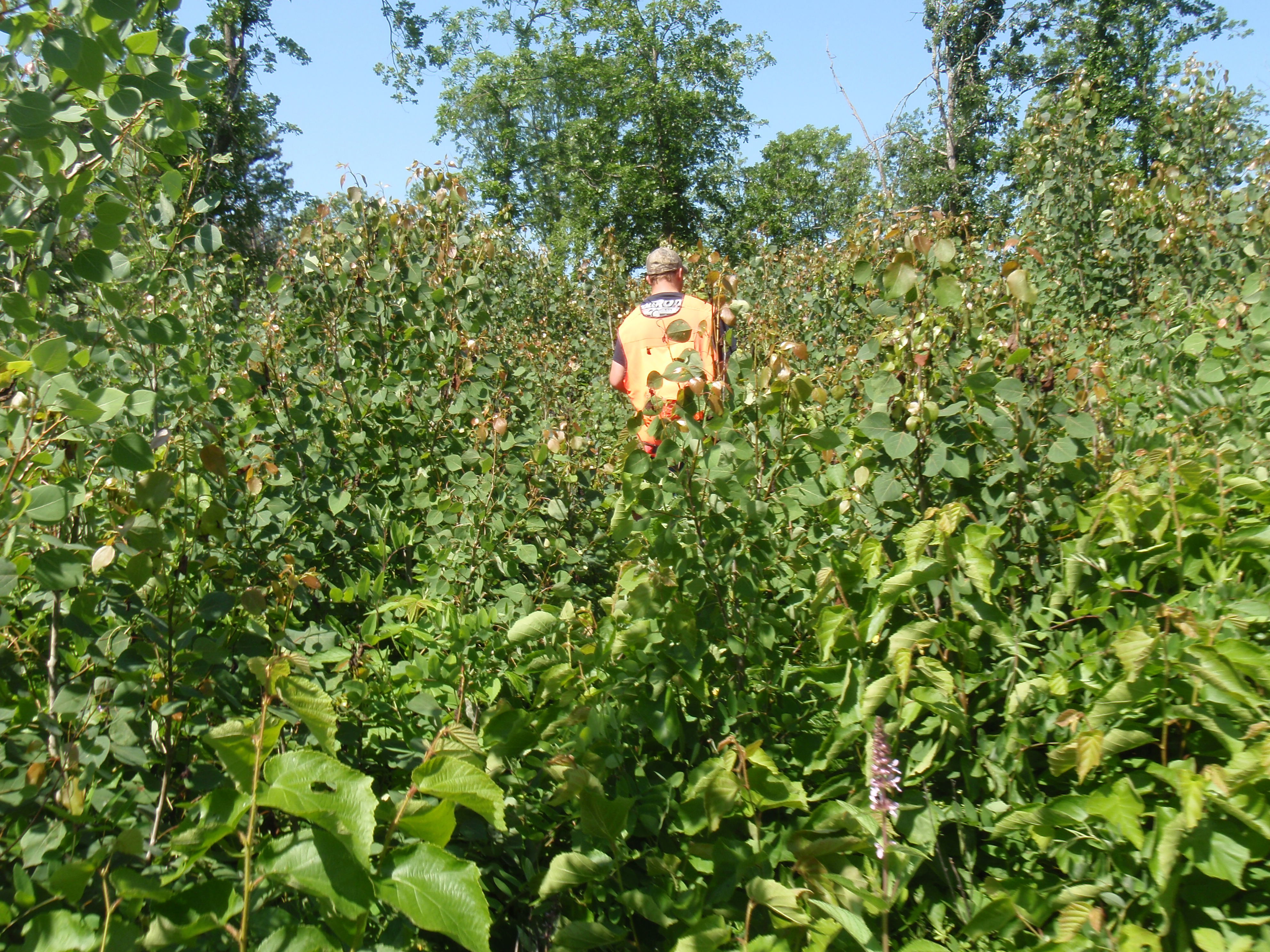
The last couple of weeks have been busy.  Stocking surveys have largely consumed my life at work.  These surveys are mandated by law for the forest to complete to check on recovery rates.  The Chippewa has always done well in both stocking surveys as well as assisting in the restoration of forests.  Over a million and a half trees are planted each year here!  1.5 million.  1,500,000 baby trees in the ground a year.  We’ve got a pretty darn good survival rate and the Blackduck Ranger District is the proud owner of the tree cooler that houses the trees before transplanting.

Beaver Dam found during a survey

Beaver Dam found during a survey

Based on the fun scale with type 1 being fun in the moment, type 2 being fun after the fact, and type 3 never fun- it seems safe to say that stocking surveys are most definitely a type 3 fun.  We keep hoping for a hot and dry streak to kill off some mosquitoes but it’s rained every weekend without fail. Rain often makes an appearance weekday evenings while we sleep.  If nothing else the ticks have slowed down in activity.  The mosquitoes overall have decreased and in turn have been replaced by a spike in the number of deer flies.  It’s the worst when you’re doing a survey where there’s an abundance of both.  Your mosquito net hardly stands a chance against the forces of nature.

Butterfly atop raspberry plants

I was mistaken when I previously stated that we only survey naturally regenerated units.  We do survey planted units but they are few and far between (and a lot easier to survey than natural units).  Fire’s been generous enough to lend their three seasonals to us for a day and were going to help us with more days but the rest of them just received a call today to go West.  One of the fire crew members is already in Washington while the other two and a recreational seasonal will fly out to my home state.  The fires are furious and the land is dry.

Karl (fire crew)  heads to the next point

Karl (fire crew) heads to the next point

Zack, Jarrod, and I have been trucking along with stocking surveys as they have an August deadline of when all the data needs to be collected and then entered onto the computer.  We’re more than halfway through but it seems like an eternity before we finish the last few dozen units.  The ground we trek through has oftentimes been marshy and unpleasant, resulting in many days with soaked boots.  Luckily timber supervisor Corey ordered several boot dryers for the bunkhouse which have been lifesavers.

Typical sight

Typical sight

During all of this I’ve been lucky enough to utilize a smidgen of GIS technology to create the maps for the points as well as to locate the units.  Turns out the predetermined points within a unit actually follow a formula based on acres to determine how many points are within a unit.  Also as map maker I place the points in as random a fashion as possible.  None of the GIS is complicated but I’m extremely excited to have been on ArcMap this summer.

An example map of a sale.  More detailed maps of each unit were made in addition to the overall map.

An example map of a sale. More detailed maps of each unit were made in addition to the overall map.

Raspberries for days

Raspberries for days

A well deserved snack

A well deserved snack

Although the going is tough, the wild berries almost make the task worth it.  Like many northern states, Minnesota is home to an abundance of raspberries, blueberries, and strawberries.  Wild berries tend to be on the smaller side than their farmed counterparts and that’s especially true of strawberries.  I’ve seen some decent blueberries that could almost rival farmed varieties though.  I’ve even been introduced to berries I’ve never heard of before like June berries.  A quick hand grabs a berry or two as we hike and slips it under the mosquito net, hoping that mosquitoes didn’t follow that hand.  There’s not a lot that can panic me more on a survey than a mosquito buzzing in the space between the net and my face.


Through the course of stocking surveys we’ve encountered all sorts of terrain.  True most of it is swampy but occasionally we get dry land or strange marshes.  Once in awhile Zack and I have even encountered a hill.  Elevation’s a rare beast here and it’s always exciting for us two folks from the West.  We joke that we’ve Minnesota based jumped when I accidentally dropped two feet into a dip.

Zack leads on during a rainy day

Aspens are overwhelmingly the majority of saplings

Aspens are overwhelmingly the majority of saplings


A quick recap of how stocking surveys are done-
1) drive as close to site as highways and forest roads allow
2) hike in, try to stay dry (never works)
3)usually start at furthest point and work our way back towards the truck
4)one person runs a 11.8 feet circle plot while the other records
5)note saplings’ height and DBH (diameter at breast height)
6)shoot large trees with a 10-basal area factor prism
7)measure DBH of ‘in’ trees and height (using a clinometer)
8)move on to next point and repeat

11.8 feet out

11.8 feet out

Measuring DBH

Measuring DBH


Timber’s aiming to slam the rest of the surveys and finish in about a week, two at the maximum.  After that a significant amount of data entry awaits us.  Zack’s been entering the data we compile from the field into a program called examsPC but I’ll be left with the FACTS data entry that results from that.  It’s far from exciting work but necessary in resource management within a forest.


OLYMPUS DIGITAL CAMERAOLYMPUS DIGITAL CAMERA

Wild strawberry!

Wild strawberry!


Design a site like this with WordPress.com
Get started