The USFS was at the Minnesota State Fair on August 22nd to inform the public about the 2014 Capitol Christmas Tree which is coming from the Chippewa. Talk about killer. I got to travel down with folks from the office as we spent a couple of days in St. Paul. At the state fair there were tables set up so that folks could make ornaments for the tree. The state fair is significantly larger than any in Washington and I must confess that I was overwhelmed. It’s common knowledge that you can find practically everything and anything on a stick here, most likely deep fried as well. There were some amazing displays and so much going on.
Again I can’t figure out how to format the photographs to fit together so I apologize for the lack of structure.
Random critters were scattered around Como Park in St. Paul.
Como Park
Como Park
Como Park
What a building!
My supervisor Lisa in the middle.
State Fair Crew
Sleeping on the ground so they gave me all the pillows…?
Patti informing guest about the USFS.
Sweet youth based program!
Holler at Beltrami.
Way too many people for comfort.
Milk samples, of course.
Wendy, the woman who keeps the office organized.
Structure in the background is the swine building.
Biggest boar, 800 pounds.
Holy smokes quilt
Delicious cider! Can’t wait for fall in Washington.
Blueberries out of all berries have a permanent hold on my heart. They are physical embodiment of grand memories with even grander people. Blueberries are a quick break while doing trail work with my best friend Emily while we served on hitches in the White Mountains (NH). They’re hiking around Acadia with some friends from SCA’s NH Corps and getting to enjoy Maine’s renown berries. It’s seeing someone one last time, capping off a day of swimming below a waterfall with an important friend before she moves from Washington to South Carolina for six years of grad school. Now it’s picking with folks from my first federal position and getting to enjoy the beauty that Minnesota offers.
Some fool wore chacos… lessons learned.
First go
Zack the forager
First pickin’
My like for berries, especially wild ones, should have been evident by now. Wherever we do stocking surveys Zack and I run into raspberries plants and oftentimes blueberries in addition. We’ve seen strawberry plants but they’ve long passed their prime and have been bare for weeks. During a survey I once asked Zack if he ever felt like a bear when he picks berries. He replied yes and I was relieved to know I wasn’t the only one who thought that way. There’s a decent chance he could’ve just been humoring me but…
Second time around
On Thursday Sarah from the recreation department did stocking surveys with me while Zack check cruised some timber with our supervisor Corey. Our survey site was located off the Southeast corner of Decker Lake and my, oh my! Berries as far as you could see. Nearest to the road were blueberries and as you traveled further south to the survey, raspberries. It was a perfect picking moment as the mosquitoes weren’t out and the deer flies were hardly a nuisance. However our mission was to complete the stocking survey in order to move on to a new site- of course it goes without saying we did grab a berry or two as we walked.
Generally being a less than observant person, I excited told Wendy at the office of our find that afternoon. My excitement spreading, Wendy decided that she was going to pick berries after work and easily convinced me to go along. Linda was in as well and we all met up at six and set off. Come to find out, the site I was so stoked about was where Wendy, some of the seasonals (Zack, Ben, Art, Karl), and myself had gone to our first and only other time berry picking. This time we were on the South side of the road though.
Wendy fears no mosquitoes
It was a glorious picking as we nearly had our buckets filled in less than two hours whereas the first time around I didn’t even have my bucket a third of the way full in what was probably about the same time frame.
Second pickin’
There wasn’t enough time to go after raspberries with the blueberry bushes loaded with tiny fruit. What was I to do with what would be over 24 cups of blueberries? I talked about canning them on the ride home and Wendy just happened to have a pot and extra jars/lids/bands I could use and was kind enough to drop them off that Friday morning.
Honey!
Never having canned anything before I spent what might’ve been a ridiculous amount of time reading how to can and jam recipes before going with a simple berry, honey, and lemon juice one. The viscous honey eliminated the need for pectin which I was more than happy about. I finally got around to processing the berries and making jam on Saturday which turned into an over six-hour ordeal. With the mosquitoes biting during berry picking I had put quantity over quality end ended up with heaps of leaves and twigs in my bucket that I had to separate from the berries. Making the jam itself and canning it was actually the quick part. We’ll see how the jars keep and travel as I plan to ship them to my folks in Washington. Although the freshly made jam was delicious on just as freshly baked bread.
The last couple of weeks have been busy. Stocking surveys have largely consumed my life at work. These surveys are mandated by law for the forest to complete to check on recovery rates. The Chippewa has always done well in both stocking surveys as well as assisting in the restoration of forests. Over a million and a half trees are planted each year here! 1.5 million. 1,500,000 baby trees in the ground a year. We’ve got a pretty darn good survival rate and the Blackduck Ranger District is the proud owner of the tree cooler that houses the trees before transplanting.
Beaver Dam found during a survey
Based on the fun scale with type 1 being fun in the moment, type 2 being fun after the fact, and type 3 never fun- it seems safe to say that stocking surveys are most definitely a type 3 fun. We keep hoping for a hot and dry streak to kill off some mosquitoes but it’s rained every weekend without fail. Rain often makes an appearance weekday evenings while we sleep. If nothing else the ticks have slowed down in activity. The mosquitoes overall have decreased and in turn have been replaced by a spike in the number of deer flies. It’s the worst when you’re doing a survey where there’s an abundance of both. Your mosquito net hardly stands a chance against the forces of nature.
Butterfly atop raspberry plants
I was mistaken when I previously stated that we only survey naturally regenerated units. We do survey planted units but they are few and far between (and a lot easier to survey than natural units). Fire’s been generous enough to lend their three seasonals to us for a day and were going to help us with more days but the rest of them just received a call today to go West. One of the fire crew members is already in Washington while the other two and a recreational seasonal will fly out to my home state. The fires are furious and the land is dry.
Karl (fire crew) heads to the next point
Zack, Jarrod, and I have been trucking along with stocking surveys as they have an August deadline of when all the data needs to be collected and then entered onto the computer. We’re more than halfway through but it seems like an eternity before we finish the last few dozen units. The ground we trek through has oftentimes been marshy and unpleasant, resulting in many days with soaked boots. Luckily timber supervisor Corey ordered several boot dryers for the bunkhouse which have been lifesavers.
Typical sight
During all of this I’ve been lucky enough to utilize a smidgen of GIS technology to create the maps for the points as well as to locate the units. Turns out the predetermined points within a unit actually follow a formula based on acres to determine how many points are within a unit. Also as map maker I place the points in as random a fashion as possible. None of the GIS is complicated but I’m extremely excited to have been on ArcMap this summer.
An example map of a sale. More detailed maps of each unit were made in addition to the overall map.
Raspberries for days
A well deserved snack
Although the going is tough, the wild berries almost make the task worth it. Like many northern states, Minnesota is home to an abundance of raspberries, blueberries, and strawberries. Wild berries tend to be on the smaller side than their farmed counterparts and that’s especially true of strawberries. I’ve seen some decent blueberries that could almost rival farmed varieties though. I’ve even been introduced to berries I’ve never heard of before like June berries. A quick hand grabs a berry or two as we hike and slips it under the mosquito net, hoping that mosquitoes didn’t follow that hand. There’s not a lot that can panic me more on a survey than a mosquito buzzing in the space between the net and my face.
Through the course of stocking surveys we’ve encountered all sorts of terrain. True most of it is swampy but occasionally we get dry land or strange marshes. Once in awhile Zack and I have even encountered a hill. Elevation’s a rare beast here and it’s always exciting for us two folks from the West. We joke that we’ve Minnesota based jumped when I accidentally dropped two feet into a dip.
Zack leads on during a rainy day
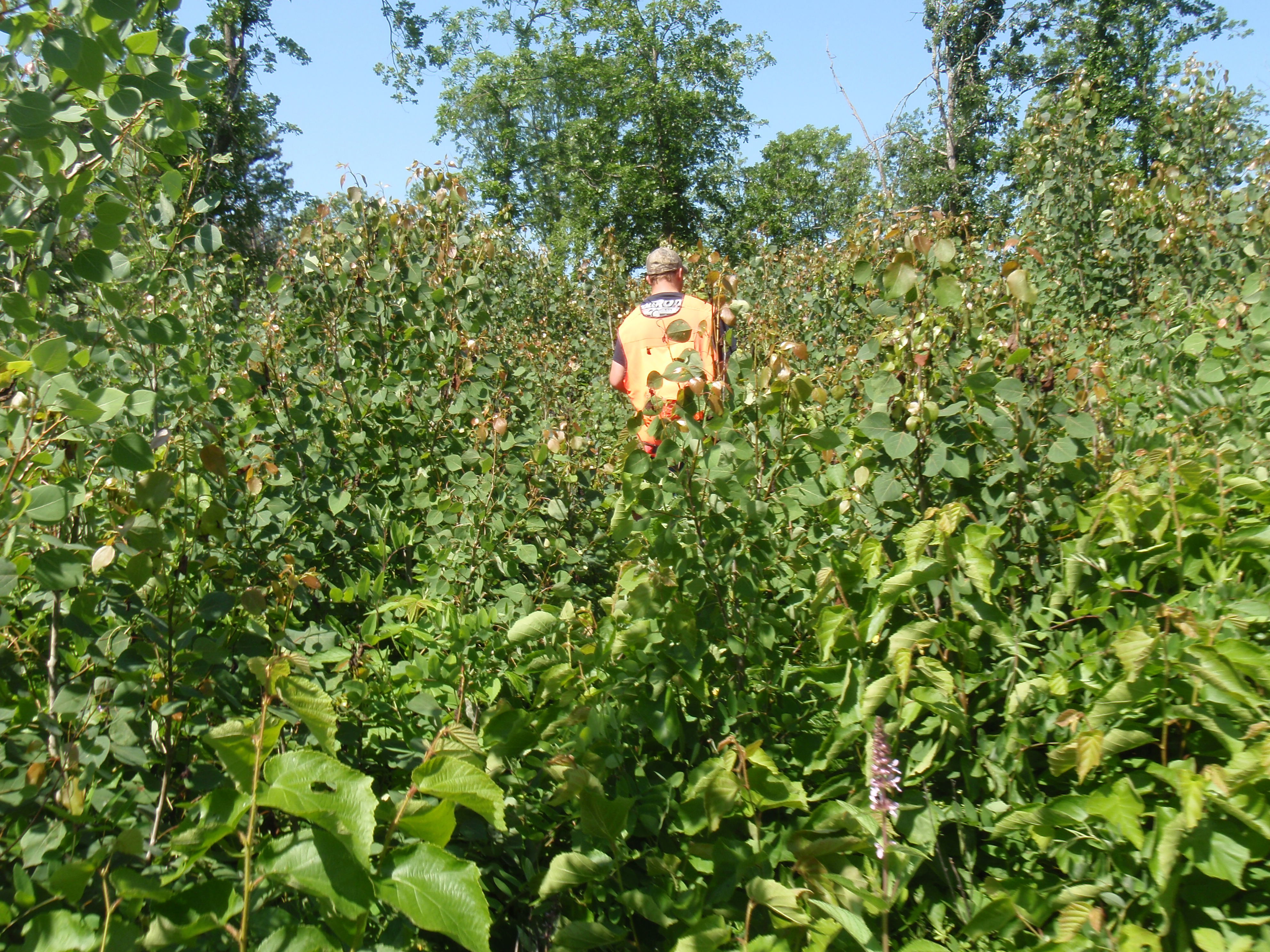
Aspens are overwhelmingly the majority of saplings
A quick recap of how stocking surveys are done- 1) drive as close to site as highways and forest roads allow 2) hike in, try to stay dry (never works) 3)usually start at furthest point and work our way back towards the truck 4)one person runs a 11.8 feet circle plot while the other records 5)note saplings’ height and DBH (diameter at breast height) 6)shoot large trees with a 10-basal area factor prism 7)measure DBH of ‘in’ trees and height (using a clinometer) 8)move on to next point and repeat
11.8 feet out
Measuring DBH
Timber’s aiming to slam the rest of the surveys and finish in about a week, two at the maximum. After that a significant amount of data entry awaits us. Zack’s been entering the data we compile from the field into a program called examsPC but I’ll be left with the FACTS data entry that results from that. It’s far from exciting work but necessary in resource management within a forest.
Conservation is a huge part of my life- it’s both my passion and how I got to where I am today. It would be an understatement to say that the conservation life is a large part of who I’ve become as well.
It’s hard to say when it all began. There isn’t a date or event where I could tell you when my obsession for the outdoors began. Born to parents who are city folks, it’s a mystery to some that I would rather spend the summer outdoors and under the stars rather staying in Seattle. An unknown force pulls at my heartstrings when I see evergreen trees and snow capped mountains, knowing that the most wonderful of days await me. It goes without saying that those wild and free days are typically accompanied by the best people I’ll ever meet.
Winter retreat YESC
Yellowstone with YESC 2009
In high school I was part of a club called Earthcorps. We recycled cans and bottles within the school and had a partnership with the YMCA Earth Service Corps (YESC) who held monthly service projects around King County. YESC was my gateway to the conservation world and exposed teenage me to all sorts of adventures that I never would’ve had otherwise. With seasonal retreats, service projects, and summer trips I fell deeper in love with nature and the bounties it promised.
Outward Bound 2007
Through YESC I was able to go on a multi-week Outward Bound white water rafting trip with a crew of other teens in the majestic brilliant Southwest. We lost track of time, rising when the sun did and sleeping when night fell. The desert sky held the most stars I have ever seen to this day. Days were spent paddling and the meals we cooked each evening were out of this world. Outward Bound might’ve been my first experience in meeting folks that I might never see again but would be happy to share a meal with any time.
YESC introduced me to one of my favourite activities: trail work. It’s the building and maintaining of trails and one summer they teamed up with the Washington Trails Association (WTA, check them out at www.wta.org !) for a youth volunteer vacation. A crew of capable young women, YESC/YMCA staff, and a couple of WTA leaders equated to a fantastic week in the Gifford Pinchot National Forest. We worked just North of Mount St. Helens, brushing and restoring tread on a trail that hadn’t received much love in years. Although I’ve used various hand tools before I met the Pulaski for the first time as well was the McLeod (the value of which I would learn years later). The work we got done was incredibly empowering. And again the meals were always solid- there’s something about dinners after a day of doing work outside, knowing that you had a cozy tent waiting. I’ve yet to had a terrible meal when camping.
WTA camp 2009
WTA with YESC 2009
Grand Canyon, SCA ASB 2010
Satellite Nursery, SCA ASB 2010
Time passed and I was on my way to wrapping up my associates degree fall 2010 without much direction. The only thing for certain was that I didn’t want to transfer to a university right away. It was summer of 2010 and previously in March I had gone on an alternative spring break trip with the Student Conservation Association (SCA) to the Grand Canyon where 30 college students from around the United States did service projects instead of partying in the tropics. There’s nothing like sleeping below the sky, frozen by the yipping howl of coyotes and the knowledge that cougars circled the campgrounds at night. Fact because you went to a presentation by a ranger who had solid data from a tracking collar. This was yet another instance in which friends that you might only ever see once came about.
SCA NH: Learning what it means to actually snow
Murder mystery in the lodge; photo credit to Emily Lord
My friend Lauren gave me the obvious answer to my question of what to do post community college. “Why don’t you get an internship with SCA?” and so I ended up in New Hampshire for 10 months in the middle of a state park with 30 or so other folks in their 20s (two of us were 19 at the start). SCA New Hampshire Corps has been an a major player in the decisions I’ve made the last few years. About four months of environmental education in local elementary schools with six months of down and dirty conservation work and I was as happy as could be.
SCA NH: Jeremy Burns taking inventory of tools
I’ve been lucky enough to see some of the folks I befriended in New Hampshire again, some several times. Others I’ve yet to meet up in the three years since we split but I’m positive we’ll meet up one day. SCA NH has also introduced me to many other people in the conservation world and likewise I’ve met people who have been impacted by the corps life. Corps life is one that can never be fully explained because it is happiness, madness, and so much more. This year two of my fellow corps members from NH Corps have started their own corps in Tennessee. The Great Smoky Mountains to be precise! Sean and Heather are living the dream and continuing SCA’s legacy on youth and could really use some help in making their first season a success. Check out Smoky Mountain Corps to support what is already a great endeavour. You can also learn more about them on their Facebook page and read about how they’ll be impacting crews of young folks and the communities that they are connected to.
SCA NH: Sill bridge built in the White Mountains NF; photo credit to Emily Cook




 Pacific Northwest meets Minnesota