Pacific Northwest meets Minnesota


Leave a comment

The art of stocking

The last couple of weeks have been busy.  Stocking surveys have largely consumed my life at work.  These surveys are mandated by law for the forest to complete to check on recovery rates.  The Chippewa has always done well in both stocking surveys as well as assisting in the restoration of forests.  Over a million and a half trees are planted each year here!  1.5 million.  1,500,000 baby trees in the ground a year.  We’ve got a pretty darn good survival rate and the Blackduck Ranger District is the proud owner of the tree cooler that houses the trees before transplanting.

Beaver Dam found during a survey

Beaver Dam found during a survey

Based on the fun scale with type 1 being fun in the moment, type 2 being fun after the fact, and type 3 never fun- it seems safe to say that stocking surveys are most definitely a type 3 fun.  We keep hoping for a hot and dry streak to kill off some mosquitoes but it’s rained every weekend without fail. Rain often makes an appearance weekday evenings while we sleep.  If nothing else the ticks have slowed down in activity.  The mosquitoes overall have decreased and in turn have been replaced by a spike in the number of deer flies.  It’s the worst when you’re doing a survey where there’s an abundance of both.  Your mosquito net hardly stands a chance against the forces of nature.

Butterfly atop raspberry plants

I was mistaken when I previously stated that we only survey naturally regenerated units.  We do survey planted units but they are few and far between (and a lot easier to survey than natural units).  Fire’s been generous enough to lend their three seasonals to us for a day and were going to help us with more days but the rest of them just received a call today to go West.  One of the fire crew members is already in Washington while the other two and a recreational seasonal will fly out to my home state.  The fires are furious and the land is dry.

Karl (fire crew)  heads to the next point

Karl (fire crew) heads to the next point

Zack, Jarrod, and I have been trucking along with stocking surveys as they have an August deadline of when all the data needs to be collected and then entered onto the computer.  We’re more than halfway through but it seems like an eternity before we finish the last few dozen units.  The ground we trek through has oftentimes been marshy and unpleasant, resulting in many days with soaked boots.  Luckily timber supervisor Corey ordered several boot dryers for the bunkhouse which have been lifesavers.

Typical sight

Typical sight

During all of this I’ve been lucky enough to utilize a smidgen of GIS technology to create the maps for the points as well as to locate the units.  Turns out the predetermined points within a unit actually follow a formula based on acres to determine how many points are within a unit.  Also as map maker I place the points in as random a fashion as possible.  None of the GIS is complicated but I’m extremely excited to have been on ArcMap this summer.

An example map of a sale.  More detailed maps of each unit were made in addition to the overall map.

An example map of a sale. More detailed maps of each unit were made in addition to the overall map.

Raspberries for days

Raspberries for days

A well deserved snack

A well deserved snack

Although the going is tough, the wild berries almost make the task worth it.  Like many northern states, Minnesota is home to an abundance of raspberries, blueberries, and strawberries.  Wild berries tend to be on the smaller side than their farmed counterparts and that’s especially true of strawberries.  I’ve seen some decent blueberries that could almost rival farmed varieties though.  I’ve even been introduced to berries I’ve never heard of before like June berries.  A quick hand grabs a berry or two as we hike and slips it under the mosquito net, hoping that mosquitoes didn’t follow that hand.  There’s not a lot that can panic me more on a survey than a mosquito buzzing in the space between the net and my face.


Through the course of stocking surveys we’ve encountered all sorts of terrain.  True most of it is swampy but occasionally we get dry land or strange marshes.  Once in awhile Zack and I have even encountered a hill.  Elevation’s a rare beast here and it’s always exciting for us two folks from the West.  We joke that we’ve Minnesota based jumped when I accidentally dropped two feet into a dip.

Zack leads on during a rainy day
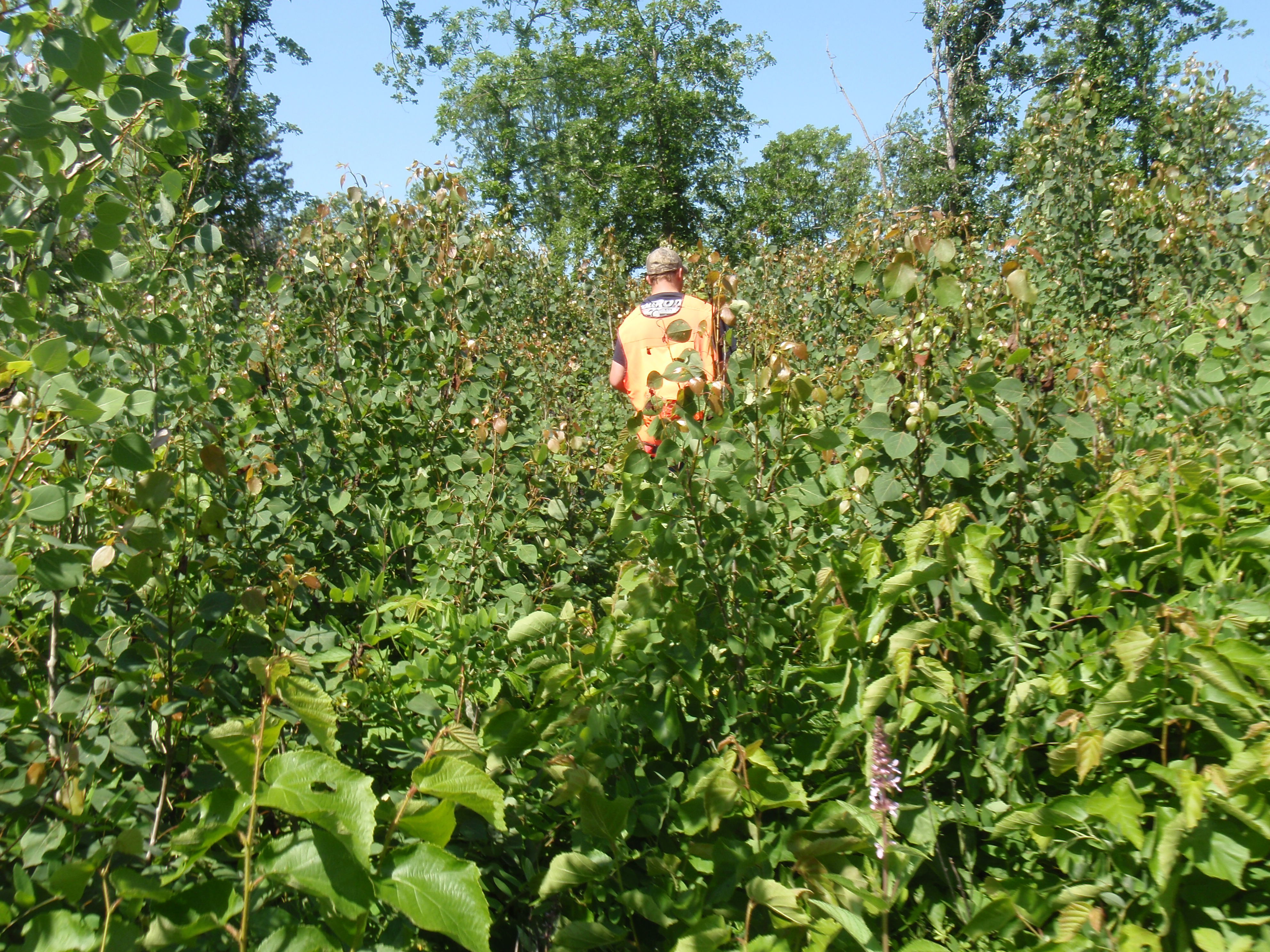
Aspens are overwhelmingly the majority of saplings

Aspens are overwhelmingly the majority of saplings


A quick recap of how stocking surveys are done-
1) drive as close to site as highways and forest roads allow
2) hike in, try to stay dry (never works)
3)usually start at furthest point and work our way back towards the truck
4)one person runs a 11.8 feet circle plot while the other records
5)note saplings’ height and DBH (diameter at breast height)
6)shoot large trees with a 10-basal area factor prism
7)measure DBH of ‘in’ trees and height (using a clinometer)
8)move on to next point and repeat

11.8 feet out

11.8 feet out

Measuring DBH

Measuring DBH


Timber’s aiming to slam the rest of the surveys and finish in about a week, two at the maximum.  After that a significant amount of data entry awaits us.  Zack’s been entering the data we compile from the field into a program called examsPC but I’ll be left with the FACTS data entry that results from that.  It’s far from exciting work but necessary in resource management within a forest.


OLYMPUS DIGITAL CAMERAOLYMPUS DIGITAL CAMERA

Wild strawberry!

Wild strawberry!


Leave a comment

Four 10s

10 hour days, four days a week.  A typical day in the Chippewa National Forest goes from 0600 to 1630 with a 30-minute lunch break somewhere around noon.  Mornings are generally a little rough as I’ve yet to get my 2130 bedtime down but the three-day weekends more than make up for it.  With Friday-Sunday of every week off I have the potential to explore Minnesota and honestly get a lot of sleeping in.  As with past internships I’m without a car so anything further than walking or biking distance is reliant on the other seasonals who are all generous fellas. 

Office Days are Messy Days

Office days are messy days

I’m mostly working with the timber division this summer but I’ll have the opportunity to learn about other crews within the Blackduck Ranger District (RD).  Our office, which is shared with Minnesota’s DNR, is located on the west side of town right off Highway 71.  A little over two dozen folks work out of the Blackduck RD while less than 800 people inhabit the town.

Washed out culvert delays timber cruising

Washed out culvert delays timber cruising

Timber cruising is the act of collecting field data on the volume and values of trees within a sale unit.  I’ll try not to go into too much detail but there are multiple ways to mark a sale.  One major plan is to mark trees to be cut and another is to mark trees to leave.  Our crew marks sample trees that qualify to be cut within a plot.  From plot center we use a cruising prism with a 10 basal area factor (10 square feet/acre) that determines whether or not a tree is “in”.  You look through the prism with one eye closed to check each individual tree.  Trees are “in” when the offset segment is still connected to the tree as shown below.   “In” trees are marked with a dot of spray paint so we don’t have to commit each tree to memory. 

Some tools of the trade

Some tools of the trade.  The bottle measures 4.3″ in diameter

Marked trees are measured with a diameter tape at breast height (DBH) which is standardized at 4.5 feet above the ground.  The diameter tape has two sides- one is regular measurements of inches and feet while the other is in elongated inches(increments are 1/10th of an inch) that allows the tape to be wrapped around the tree at DBH to get its diameter. 

Jarrod uses a clinometer

Jarrod uses a clinometer

We then measure height by standing 33 feet from the tree and using a clinometer which is a nifty sighting tool.  The number we get needs to be divided in half since our clinometer is meant for a distance of 66  feet (66 feet=1 chain) away but in these woods underbrush keeps the sight distance from getting far.  Clinometers are used with both eyes open- one eye with the clinometer right up to it and the other to see tree base and top.  Once finished recording tree species, height, DBH, and any deformities we move on to the next plot and repeat.

Zack in cruising gear

Zack in cruising gear

However due to various factors like the insane amount of mosquitoes (heightened because of the unseasonal storms) and frustrating underbrush like hazel, most of the cruising in the Blackduck RD is done either in the spring or fall/winter.  Our supervisor Corey is said to be a machine in the winter and gets through plots like none other.  He’s of the belief that cruising in the summer has a lower quality of records since workers tend to rush through measurements in an attempt to escape the bugs, which I whole heartedly support. 

Since there’s not a lot cruising going on most of our summer will be focused on stocking surveys.  In the forest folks return to sites that have been harvested at one, three, and five-year intervals to record how recovery is going.  There are predetermined points within a plot and the number of points is determined by the size of the plot.  From plot center someone runs out 11’8″ of tape (=1/100th of an acre) and records all the saplings within that span.  Saplings are corded at 0 inch diameter, 0.5 inch diameter, and so on up to 4 inches.  Anything beyond 4 inches in diameter is no longer considered a sapling.  When finished recording saplings, a prism is used to determine “in” trees and those are noted as well. It’s of utmost importance to record latitude and longitude for future reference in addition to using GPS units.  These are plots that have NOT been planted and have regenerated naturally.  The amount of greenery in these plots have been astonishing to me. 

Carhartts dry faster than you think

Carhartts dry faster than you think

On the side we’ve also done a few stake rows which take place in planted sites.  With a GPS you head out to a plot looking for specific species and flag 10 of each.  Save the location on the GPS for each species about the middle of the 10 flags.  Species we’re typically looking for are white pine, jack pine, red pine, white spruce, black spruce, tamarack, among several others.  Crews in the future will use the GPS to refer back to the points and check on the conditions of the planted trees. 

Stake rows

Stake rows

My uniform consists of boots, Carhartts, t-shirt, long sleeve shirt, timber cruising vest, hard hat, and most importantly a mosquito net.  We’ve been fortunate enough to have windy days that kept the bugs at bay but the mosquito nets might be the only thing saving my sanity at times.  I recently received forest service approved pants and a polo but they feel a lot more office-y than field apparel.  The next upcoming weeks we’ll be cranking out stocking surveys as they’re due late August and most of the seasonals depart around mid-August for college.  Here’s to good weather, less mosquitoes, and tick free days. 


Nice try ya little blood sucker

Nice try ya little blood sucker

Design a site like this with WordPress.com
Get started